The tools exist
Google announced photo-based virtual apparel try-on for the UK in 2025. This signals an emerging interface, not proof of accurate fit or lower consumption. [1]
FUTURE MARKETING · ASSESSMENT 2
What if fashion technology helped us use what we own, instead of wanting what comes next?
Watch the narrated portfolio Try the studioA speculative strategy for 2030. Fictional brand. Academic concept prototype.
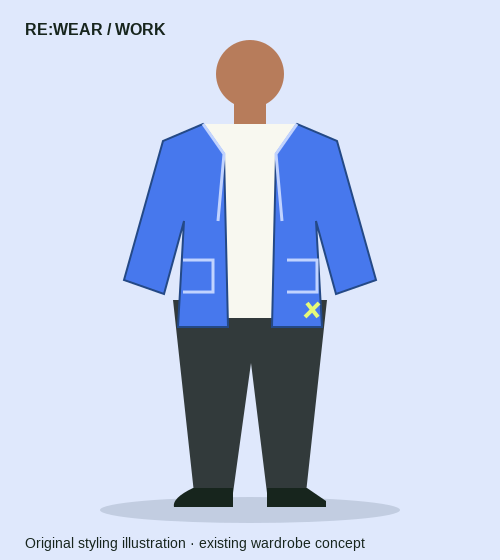
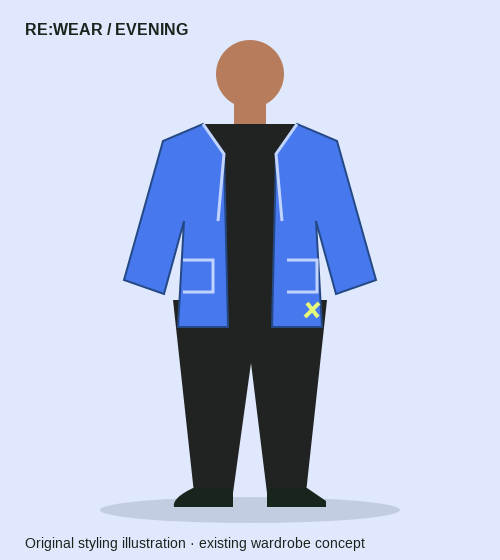
Original concept illustration / not a product listing
NARRATED PORTFOLIO
Play the chapters in order, or explore at your own pace. Pause at the studio to try the prototype. Narration uses a synthetic English voice; the complete transcript is available below.
Chapter 1 of 8
THE STRATEGIC QUESTION · 1 MINUTE
Google announced photo-based virtual apparel try-on for the UK in 2025. This signals an emerging interface, not proof of accurate fit or lower consumption. [1]
Repair, resale, rental and remaking offer alternatives to relying only on first sales. Whether they reduce impact depends on how they operate. [2]
RE:WEAR proposes styling from existing wardrobes first. Its commercial challenge is earning from useful services without accelerating replacement.
Social: identity and novelty · Technology: synthetic images and connected records · Economic: service labour and logistics · Environmental: displacement of new purchases remains unproven.
Patagonia offers care guidance and repair services, showing that garment care can be part of a brand relationship. This is a company example, not independent proof of environmental impact or a partnership with RE:WEAR. [7]
Rosa’s social acceleration lens helps question whether faster tools also intensify the pressure to keep changing. RE:WEAR’s response is to accelerate access to styling ideas while slowing the default replacement cycle. This is our strategic interpretation, not a prediction derived from the theory. [8]
THE CLASSROOM LENS · NOW / NEAR / NEXT
Frew’s classroom approach asks us to examine the cultural assumptions behind what feels normal, then explore possible and preferable alternatives. Our starting assumption to challenge: a new social occasion requires a new garment. [10]
Examine how fashion communication, social comparison and shopping habits make newness feel necessary. RE:WEAR asks users to start with what they own; this targets a cultural assumption, not just a shopping interface.
AI styling and existing repair services could make reuse easier. Test this plausible pathway against low trust and rebound consumption. It is a conditional opportunity, not a guaranteed market transition.
Explore shared avatar styling and continuing garment histories by 2030. The preferred future values expression and care; a competing future monetises identity anxiety. Neither is inevitable.
Functional: optimise a recommendation to sell a new outfit. Critical: ask why feeling appropriately dressed has become tied to buying. Creative: design new social meanings around the same garment, then test whether the business model supports that change. This applies the lecturer’s teaching sequence; it does not claim new empirical findings. [10]
FORESIGHT · 1 MINUTE 10 SECONDS
Following Voros’ distinction between analysing change and exploring alternatives, these scenarios stress-test a strategy. They are neither forecasts nor assigned probabilities. [3]
Backcasting proposal: 2027 test wardrobe usefulness and service costs; 2028 establish repair partners and correction procedures; 2029 expand only after behavioural evidence; 2030 scale conditionally.
AUDIENCE & IDENTITY · 50 SECONDS
A 27-year-old UK city resident who enjoys style, has a limited clothing budget and wants more outfit options from an existing wardrobe. This persona is a targeting hypothesis, not an interview finding.
Job to be done: feel appropriately dressed for work, evenings and weekends without restarting the wardrobe each time.
In Frew’s assessment video, the term describes a customer for whom technologies have become part of everyday life. Our scenario translates this into a wardrobe connected to a user-controlled styling assistant and optional shared avatar sessions—not an assumption that every customer has an implant or a headset. [11, 7:00–7:40]
Routine: before a social occasion, Alex asks for options from owned garments, compares expressions privately, and may invite a peer into a shared styling session. A physical repair can then preserve both practical use and personal history.
Psychographic hypothesis: values style autonomy and convenience, is price-conscious, and wants control over visibility and data. These motivations need research; they are not characteristics proven to apply to an age group.
Marketing consequence: communicate useful wardrobe possibilities when invited, rather than chasing Alex with replacement offers. Recommendations must be explainable and rejectable; no agent may buy or share on Alex’s behalf without approval.
Test: measure accepted versus rejected suggestions, perceived control and return use, alongside actual service outcomes. Low adoption keeps the manual route viable.
Belk’s digital extended-self perspective connects possessions and digitally mediated identity. Our application is to let a garment gain new meanings through styling and personal history. [4]
Critical tension: algorithmic styling could impose a narrow ideal. User choice, diverse examples and manual alternatives are strategic requirements.
Belk’s reembodiment and co-construction of self help us question whose ideal a digital outfit represents. The proposed shared styling room gives peers a role in meaning-making, while private outfit saving preserves control over self-presentation. This is an interpretation of the theory, not a validated customer insight. [4]
INTERACTIVE CONCEPT · 2 MINUTES
Choose a context and explore a rule-based styling example. This prototype does not run AI, upload photographs, provide XR or take service bookings.
Owned. Repaired.
Ready again.
2027 · Purchased — fictional example
2028 · Sleeve repaired — fictional example
2030 · Restyled — fictional example
Trust design: show who supplied each entry, attach evidence, allow corrections and distinguish verified records from owner statements. A ledger alone cannot make an entry true.
Concept pathway only. Quotes, partner availability and transactions are not connected.
Keep wearing it when it meets your needs. Services are options, not prompts to replace it.
PRESENCE & SYNTHETIC IDENTITY
A proposed shared styling room connects personal digital expression to a garment that already exists. Explore the spatial illustration below. All participants are fictional; this is a browser concept, not a live social world or headset XR experience.
Frew, Flinn and Tzanidis describe presence as a participant’s subjective sense of being in an environment. The proposed styling room aims for shared attention, recognition and confidence. The browser illustration communicates that intention; it does not establish that participants actually feel present. [9, pp. 9–10]
The assigned paper uses Butler to examine identity as formed through repeated acts and social norms. Applied here, recurring avatar styling and peer responses could shape what feels like “me”. This goes beyond simply choosing a digital outfit. Allow editable identities and private participation; evaluate whether platform norms narrow expression. This is an application of the paper’s argument to fashion. [9, pp. 8–10]
The assigned paper draws on Baudrillard to question the boundary between representation and lived experience. RE:WEAR asks whether an idealised digital style becomes the standard against which a physical wardrobe is judged. Hyperreality is not simply a synonym for realistic graphics. Its transhuman implication concerns changes to embodied identity and experience, not merely adding a device. The paper’s argument comes from events; transferring it to fashion is our interpretation and requires testing. [9]
A service that presents itself as freeing self-expression could also monetise comparison, personal data and repeated identity performance. Useful metrics must therefore include agency, trust and unintended purchases alongside engagement.
DARQ+ WITH A PURPOSE · 1 MINUTE
Proposed: retrieve combinations from owned items, explain recommendations and let users override them. Test usefulness and style diversity before adding body images.
Proposed: an optional shared virtual styling room linking avatar expression to physical garments. A flat image simulation is not XR; this website demonstrates the concept only.
Evaluate only if independent repair and resale partners need shared governance. Begin with a conventional database and accountable evidence. Quantum computing has no justified role here. [5]
DARQ means distributed ledgers, artificial intelligence, extended reality and quantum computing. The module uses DARQ+ for its wider transformational technology discussion. No fixed expansion of “+” is asserted here. Technology convergence and its social consequences matter more than treating the acronym as a feature checklist. [9]
MARKETING & BUSINESS MODEL · 1 MINUTE 10 SECONDS
Short creator videos: one jacket across three contexts. Social video makes the proposition visible before asking for personal data.
Measure: qualified visit rateA lightweight studio with no photo requirement. Save a useful look before deciding whether to join.
Measure: experience completionChoose wearing, repair or resale according to need. Local repair partners connect digital interest to physical service.
Measure: completed service conversionOpt-in seasonal styling and monthly same-garment community prompts. Reward knowledge and repair stories, not new purchases.
Measure: 30/90-day useful return| Dimension | Conventional sales-led model | Proposed 2030 service model |
|---|---|---|
| Value | Launch the next collection | Find new uses for existing garments |
| Customer relationship | Campaign and purchase cycle | Styling, care, repair and transfer over time |
| Marketer skills | Creative production and acquisition | Scenario planning, AI evaluation, community moderation, service coordination and evidence interpretation |
| Accountability | Clicks and sales | Useful use, service economics, trust and unintended consumption |
An analytical comparison, not a claim that all current fashion businesses follow one model.
Revenue hypothesis: optional styling membership, a transparent repair coordination fee and resale commission. Validate willingness to pay, partner capacity and contribution margin. No revenue forecast or commercial result is claimed.
Change illustrative assumptions to see why a useful repair service might still lose money. These are invented inputs for sensitivity analysis, not prices, forecasts or research findings.
Excludes fixed costs, taxes and customer acquisition. The repair partner’s own repair charge is separate. A positive contribution is not profit.
CRITICAL EVALUATION & MEASUREMENT · 1 MINUTE 30 SECONDS
First establish a baseline. Targets would follow a small pilot, rather than invented industry benchmarks.
Rebound: easier resale can finance more buying. Compare total purchasing and use, not transactions alone.
Exclusion: photo-based systems can discourage or misrepresent users. Keep manual styling and non-photo access.
Delivery: repair cost and quality may undermine trust. Test partner reliability before scaling.
Recruit a small, consent-based exploratory group; compare a wardrobe-first experience with a catalogue-first experience over several weeks. Observe usefulness, repeat wear and new purchases. Selection and reporting biases limit causal claims; this study has not been conducted.
Bocken et al. (2014) frame sufficiency around reducing consumption and production. RE:WEAR applies it through wardrobe-first suggestions and repair rewards that do not discount new clothes. However, positive brand attention could still stimulate buying. Track total purchases alongside engagement. [6]
The three scenarios turn uncertain trust and consumption responses into design choices. Backcasting sets conditional milestones; it does not make 2030 predictable. A low-trust future requires a useful service without photo uploads or immersive equipment. [3]
REFERENCE DESK
The narrated chapters and a two-minute studio demonstration form the core presentation. Optional references and expanded evidence are provided for inspection. The runtime panel reports the recorded narration duration; the complete presentation still needs a student rehearsal.
Web sources checked 23 November 2026. Academic interpretation should be reviewed alongside assigned course readings before submission.
RE:WEAR is fictional. Scenarios, persona, service model and garment history are original illustrative proposals, not fieldwork. Styling uses predetermined rules. No payments, bookings, environmental savings or user results are represented as real.
ChatGPT/Codex assisted research, English drafting, strategy structure, code, narration script and original SVG illustration. The student should review the argument, confirm course rules and disclose the final use accurately. Narration is generated using the macOS Daniel synthetic voice. Original garment illustrations were created in SVG. The audio transcript is provided on this page. The assessment brief and marking grid were checked on 23 November 2026. Classroom written notes and the assigned Frew, Flinn and Tzanidis paper were checked. The brief’s iPiP/iPuPP examples remain undefined in those inspected sources. No expansion is invented here. The assessment-video transcript (including Assessment 2), Lecture 1 Clip1 transcript, and selected course sources were inspected; the complete lecture series has not been reviewed.